Law firms
Websites that bring your firm cases in your practice area
For law firms and lawyers who want to win clients online without promising what cannot be promised. Website, Google Business Profile and AI visibility, within the Code of Professional Conduct (Código Deontológico).
Your clients look you up before they call
Recommendations still count. But people who are given your name look you up: your website, your Google Business Profile, your reviews. And those with nobody to ask search directly for “inheritance lawyer in Castellón” or ask an AI tool.
If your website is a business card with a list of practice areas, it answers none of those searches. And if it promises “guaranteed success”, it also breaches the rules of professional conduct.
A good law firm website explains, filters and builds trust, without revealing anything covered by professional secrecy.

What we do for your sector
- 01
One page per practice area and situation
Inheritance, divorce, dismissal, Second Chance Law. Each page explains the client’s situation, how you work and what happens at the first consultation.
- 02
Cases without breaching professional secrecy
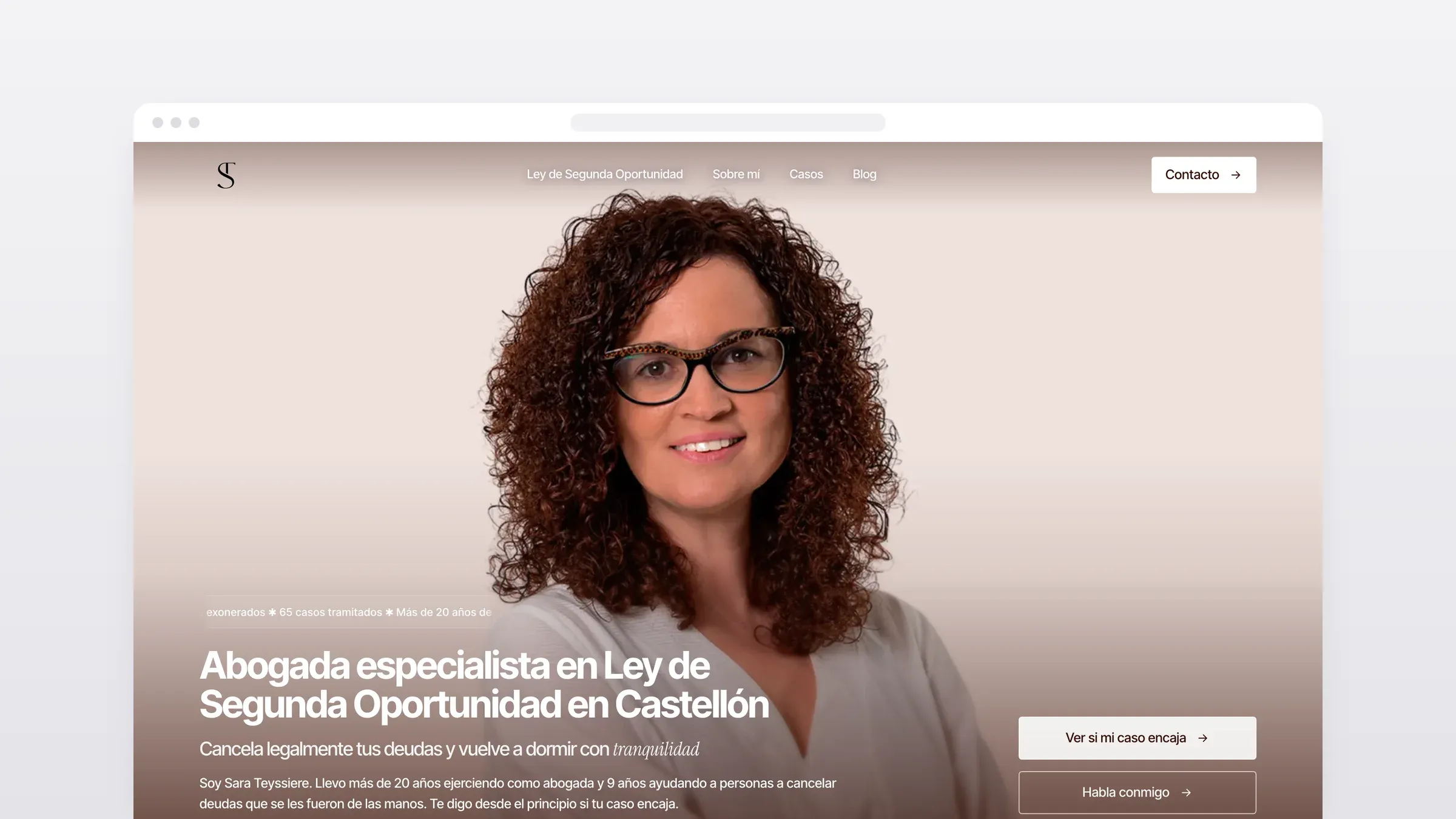
Typical situations, told without details that identify anyone. That is what we did on the website of a lawyer specialising in the Second Chance Law.
- 03
Google Business Profile and reviews
A complete profile, reviews requested from every client without incentives, and replies that never discuss the case.
- 04
AI visibility
Get ChatGPT, Perplexity or Gemini to mention you when someone asks for a lawyer in your practice area in your city.
- 05
A form that screens enquiries
Type of matter, urgency and area. So you can spend your first consultations on the cases that fit your practice area.
A project in the sector
What the Code of Professional Conduct allows, and what it does not
Advertising is allowed, within limits
The 2019 Code of Professional Conduct (article 6) allows advertising if it is objective, truthful and dignified, and requires you to state your Bar Association (Colegio de la Abogacía). It prohibits revealing information covered by professional secrecy, encouraging litigation, promising results that do not depend exclusively on the lawyer and referring to clients without their written authorisation.
What is no longer prohibited
The 2002 Code prohibited mentioning past successes and comparing yourself with other lawyers. The 2019 Code no longer includes those prohibitions, although many websites still claim they apply. What does remain in force is the Unfair Competition Act (Ley de Competencia Desleal): nothing misleading, and comparisons only if they are objective and verifiable.
Specialisms must be backed up
You can only advertise a specialism if it is backed by qualifications, accredited courses or extensive professional practice (article 6.4 of the Code).
Mandatory information on the website
Article 21 of the Code and article 10 of the Information Society Services Act (Ley 34/2002, LSSI) require you to identify yourself on the website: your name or your firm’s name, your Bar Association and your membership number.
Victims and disasters
It is prohibited to offer services to disaster victims within 45 days, or at a time when that could influence their choice. The Ethics Committee of the General Council of Spanish Lawyers (Consejo General de la Abogacía) reiterated this after the DANA floods in its Communication 213/2024.
Verifiable by anyone
Your clients can check your membership in the Castellón Bar Association register, the Valencia Bar Association search tool or the General Register of Lawyers (Censo General de Letrados). The General Council itself recommends doing so. Your details must match on the website, the Google Business Profile and the Bar Association register.
What you get
- Site structure by practice area and by client situation
- A website with the identification required by the Code and the LSSI
- Copy written with the Code of Professional Conduct to hand and approved by you
- A complete Google Business Profile, with messages to request and reply to reviews
- A form that screens enquiries by type of matter, urgency and area
- Tracking of enquiries by practice area
Guides and resources for your sector
Frequently asked questions
Straight answers to what people ask us before we start.
Can a lawyer advertise online?
Yes. The 2019 Code of Professional Conduct and Law 17/2009 on free access to service activities (Ley 17/2009) recognise lawyers’ freedom to advertise, provided it is objective, truthful and dignified and respects professional secrecy.
Can I describe cases on my website?
You can describe typical situations without details that identify anyone. Referring to specific clients requires their written authorisation, and you can never promise results that do not depend solely on you. Also, under the Code, the client’s consent does not release you from professional secrecy.
Can I ask my clients for reviews?
Yes: ask all of them, and offer nothing in return. In your replies, do not confirm or comment on any details of the case. We give you template messages that respect Google’s policy and professional secrecy.
Can I publish my fees?
Yes. Fees are freely agreed with the client, under article 14 of the Code. If you publish them, the LSSI requires you to state whether they include taxes.
Can I advertise on Google Ads?
Yes, with care. Google has its own policies: for example, debt negotiation ads have specific requirements and verifications, which affects firms handling Second Chance Law cases. We check those policies before creating campaigns, and you approve the ad copy.
Have you worked with lawyers?
Yes. We designed and built the website of Sara T., a lawyer specialising in the Second Chance Law in Castellón. You can see the case study in our portfolio.
Does your website bring in cases in your practice area?
Tell us your practice area and where you work. We will tell you what people are searching for, who shows up today and what we would do first, within the Code.
Or email us at [email protected] or message us on WhatsApp.